The parable of the sower stands among Jesus’ most well-known and frequently preached teachings. It appears in all three Synoptic Gospels and consistently ranks among the most beloved of Jesus’ parables, often alongside the prodigal son. It is taught through lectionaries, songs, Sunday school lessons, and countless sermons across the world. Almost every churchgoer is familiar with its imagery: seed, soil, birds, thorns, and harvest.
Yet in spite of that familiarity, one central truth of the parable is often overlooked or misunderstood: Jesus explicitly identifies the seed as “the word of the Kingdom” (Matt. 13:19). The soils, therefore, do not merely represent most churchgoers who never heard the message—they are different and often deficient human responses to that word about the Kingdom. When that meaning is obscured, distorted, or replaced with something else, the result is predictable: the fruit Jesus expects cannot fully appear.
Understanding this parable, then, is not merely some academic, unimportant “little deal.” It is a matter of life and death. Only when that true seed of the Kingdom is rightly explained and received can the harvest Jesus envisioned begin to emerge.
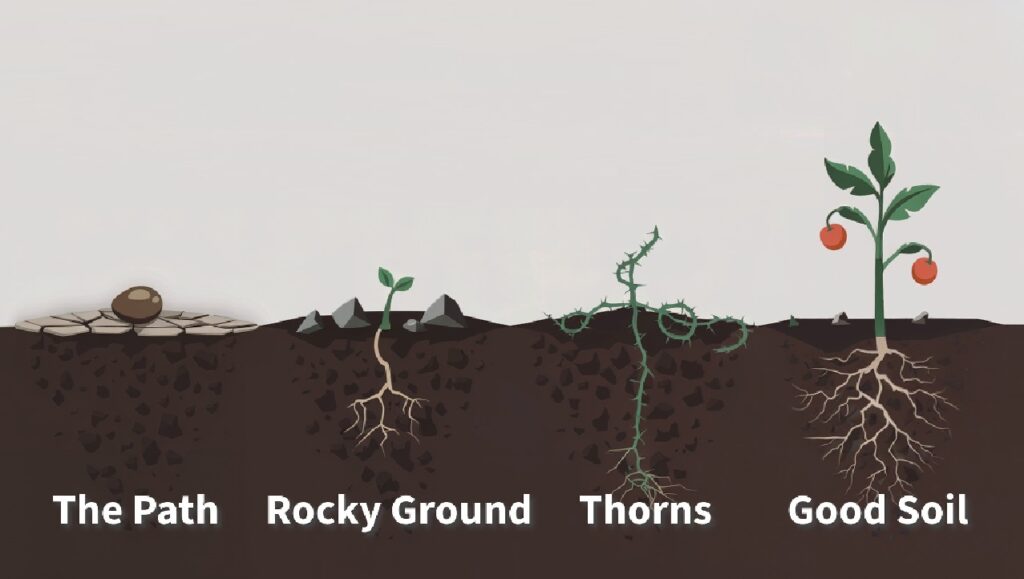
Jesus presents four soils, but the first three are explicitly negative.
1. The Hard Path – No Understanding (Matthew 13:19)
Here the seed is sown, but it is never received with understanding. It lies exposed on the surface, and the enemy immediately removes it. This soil does not represent churchgoers who never hear the message. Rather, it represents those who do hear—but without comprehension.
Many churchgoers fit this category. They attend regularly. They hear sermons. They sing the songs. They possess some familiarity with the parable’s language (the word, kingdom, etc.). Yet the message never penetrates. Often this is due to poor, shallow preaching-teaching, or a distortion of Jesus’ actual message about the Kingdom. In many pulpits the parable is reduced to “repent and believe,” self-help moralism, or even prosperity teaching—anything but what Jesus actually said.
Like seed scattered on a sidewalk, the message never takes root. By Monday it is gone—crowded out by distraction, doubt, and the pressures of ordinary life, while the enemy quietly steals what was never truly understood.
2. The Shallow Soil – Superficial Faith (Matthew 13:20–21; cf. Luke 14:27–33)
This soil receives the word with immediate joy. There is enthusiasm, excitement, even emotional response—but no depth. Because there is no root system, the plant cannot survive hard conditions. When pressure, suffering, or cost arrives, faith quickly collapses.
True reception of the word requires more than an initial emotional response. It requires sound discipling, personal accountability (constant, serious engagement with Scripture), and a willingness to count the cost of following Jesus. Without these, faith remains shallow.
This is the convert who joins during a season of excitement but fades when Christianity requires sacrifice. Like a plant growing in a thin layer of soil over rock, it appears healthy for a moment—but it has no staying power.
3. The Thorny Soil – Worldly Distractions (Matthew 13:22)
This soil may represent the largest category of most churchgoers. The word is genuinely received, and real growth begins. Yet the same soil is already crowded with rival growth: the worries of life, the pursuit of wealth, fear, ambition, entertainment, politics, and countless distractions.
These churchgoers sincerely love Jesus and may produce humanitarian fruit (feeding the poor, helping the neighbor, etc.). They keep a constant church membership. But fruit remains minimal because the plant is fighting for survival among stronger, faster-growing thorns. The Kingdom word is not rejected—it is simply crowded out.
Jesus makes clear that divided loyalties eventually suffocate genuine fruitfulness.
Jesus immediately follows the Sower with the parable of the weeds, strengthening and reinforcing the same warning. He explicitly identifies “the field as the world” (v. 38), where good seed and bad seed grow together until harvest. Both are widespread. Both are visible. Both remain intertwined for a time.
This mixture exists not only in the world at large but even within the church. False teaching, worldly values, and spiritual compromise often grow alongside genuine faith. And more sobering still, in many individuals wheat and weeds, good soil and bad soil, are tangled together in the same life.
Most churchgoers hear or read about the parable of the sower, yet many lack a clear understanding of the seed as “the word of the Kingdom.” As a result, they themselves become part of the negative soil categories—not because they never heard “the word” or about “the kingdom of God,” but because it has never been clearly planted and therefore truly understood. Without this, a true harvest cannot be produced.
God, through the man He has appointed (Acts 17:31), will hold all people accountable according to the truth available to them (Luke 12:48). Yet misunderstanding the parable does not excuse one from its warning. Jesus explicitly describes those who “do not understand” (Matt. 13:19), those who fall away under pressure (Matt. 13:20–21), and those who are choked by worldly concerns (Matt. 13:22).
Paul reminds us that faith comes from hearing a proclaimed message (Rom. 10:14–17). Jesus adds the solemn warning:
“Take care how you hear” (Luke 8:18).
A person may be exposed to the parable a few or countless times and still never truly understand what it means. Today the parables of Jesus are proclaimed not only from pulpits, but through radio, television, and the global internet.
The seed, the gospel about the Kingdom, continues to be scattered across the whole world (Col. 1:23), falling on every type of soil.
The real question is: What kind of soil will we be?


Signature: YLnQvfddA2MpNbRD5eQ6rDm65YEl/n6q8Gt96f/bJ8VtPGewgxlxjb6Zg1AmwmNGs2XFSBBKedheDop43SyiV0Ev/kXIuXJ0qdxgfRkRqJqE8dzr1o0sIqvqjtTKi3/CO5lJLXye1eD0uH4Uaz75R4e5omhEpD716ZGGmxqUEsTiIYp5frNuVPIs13wwezvQDf1dL6s3vFE9tOD2EwFMWlH2PfwpVNJ2WDPTJiCWoPs92OZ8ndCk1YbQs+a5xYQm/Cb1IRJB/9xxKcMvbrikqns7yK9ki7DmUxwOrMxDA1TzQqu6eKCq9dMAzCyyaimKXN6vDPA2QTSQSHcs2/XzD24gheKgmbbq5/lCmUf1RWBL1xtL71kYB+JXPlroLzvx4aysGOg1rd4/I4liBNjVIfhrmMKX1TeSK3nDJGqHw4cS+l7vSGzRkA9Qf+Mx8Ql1XwonDFYpaYz5M5ZdYy/j7Hb9iLQuqNLycln1UUQV27QLgkrsKnPnhgFO9X18Zbohbq4T5mt7IEgE9nfe5HEEX7ABx9QW5+c37Gb+tg+/1CZ4cx51nbLiZduq9q7NqKUtX9ypyg2Ci2FZvx8qQULni99LwpB2vcnzta8Dg3AyRYFm986mQbZRmw8YESg+f+12dMb7Nj5BaUe9YmPRTbmatiX7IbjXJzaz1HdMblGtxJwt9/eg8IC7riANPVpzdrKssQH67X/dvrzfPPKO8ZAjzBB0d6sTKZu7UnauBWWqfHEmfRWjeeWcIbZqtY0Kf9G64uWjPGaMGu5wF09EWZ9T5WiZKtwykW9Jld/H/lH2XJqoeDrGpe9tNIIS3dXWB9Xq/8a26h1fzWaRgCIiCaw6kArCvSuhZVfJHdMRgT1zacKyIOb37NYcsGzlFDKjsaW0D51opdJPmssaIywaDn/tmnuIJITlav8EVr5rL5zsoxeFlJX4wN0DRcc8Ghsq8gct

Signature: YLnQvfddA2MpNbRD5eQ6rDm65YEl/n6q8Gt96f/bJ8VtPGewgxlxjb6Zg1AmwmNGs2XFSBBKedheDop43SyiV0Ev/kXIuXJ0qdxgfRkRqJqE8dzr1o0sIqvqjtTKi3/CO5lJLXye1eD0uH4Uaz75R4e5omhEpD716ZGGmxqUEsTiIYp5frNuVPIs13wwezvQDf1dL6s3vFE9tOD2EwFMWlH2PfwpVNJ2WDPTJiCWoPs92OZ8ndCk1YbQs+a5xYQm/Cb1IRJB/9xxKcMvbrikqns7yK9ki7DmUxwOrMxDA1TzQqu6eKCq9dMAzCyyaimKXN6vDPA2QTSQSHcs2/XzD24gheKgmbbq5/lCmUf1RWBL1xtL71kYB+JXPlroLzvx4aysGOg1rd4/I4liBNjVIfhrmMKX1TeSK3nDJGqHw4cS+l7vSGzRkA9Qf+Mx8Ql1XwonDFYpaYz5M5ZdYy/j7Hb9iLQuqNLycln1UUQV27QLgkrsKnPnhgFO9X18Zbohbq4T5mt7IEgE9nfe5HEEX7ABx9QW5+c37Gb+tg+/1CZ4cx51nbLiZduq9q7NqKUtX9ypyg2Ci2FZvx8qQULni99LwpB2vcnzta8Dg3AyRYFm986mQbZRmw8YESg+f+12dMb7Nj5BaUe9YmPRTbmatiX7IbjXJzaz1HdMblGtxJwt9/eg8IC7riANPVpzdrKssQH67X/dvrzfPPKO8ZAjzBB0d6sTKZu7UnauBWWqfHEmfRWjeeWcIbZqtY0Kf9G64uWjPGaMGu5wF09EWZ9T5WiZKtwykW9Jld/H/lH2XJqoeDrGpe9tNIIS3dXWB9Xq/8a26h1fzWaRgCIiCaw6kArCvSuhZVfJHdMRgT1zacKyIOb37NYcsGzlFDKjsaW0D51opdJPmssaIywaDn/tmnuIJITlav8EVr5rL5zsoxeFlJX4wN0DRcc8Ghsq8gct


Signature: YLnQvfddA2MpNbRD5eQ6rDm65YEl/n6q8Gt96f/bJ8VtPGewgxlxjb6Zg1AmwmNGs2XFSBBKedheDop43SyiV0Ev/kXIuXJ0qdxgfRkRqJqE8dzr1o0sIqvqjtTKi3/CO5lJLXye1eD0uH4Uaz75R4e5omhEpD716ZGGmxqUEsTiIYp5frNuVPIs13wwezvQDf1dL6s3vFE9tOD2EwFMWlH2PfwpVNJ2WDPTJiCWoPs92OZ8ndCk1YbQs+a5xYQm/Cb1IRJB/9xxKcMvbrikqns7yK9ki7DmUxwOrMxDA1TzQqu6eKCq9dMAzCyyaimKXN6vDPA2QTSQSHcs2/XzD24gheKgmbbq5/lCmUf1RWBL1xtL71kYB+JXPlroLzvx4aysGOg1rd4/I4liBNjVIfhrmMKX1TeSK3nDJGqHw4cS+l7vSGzRkA9Qf+Mx8Ql1XwonDFYpaYz5M5ZdYy/j7Hb9iLQuqNLycln1UUQV27QLgkrsKnPnhgFO9X18Zbohbq4T5mt7IEgE9nfe5HEEX7ABx9QW5+c37Gb+tg+/1CZ4cx51nbLiZduq9q7NqKUtX9ypyg2Ci2FZvx8qQULni99LwpB2vcnzta8Dg3AyRYFm986mQbZRmw8YESg+f+12dMb7Nj5BaUe9YmPRTbmatiX7IbjXJzaz1HdMblGtxJwt9/eg8IC7riANPVpzdrKssQH67X/dvrzfPPKO8ZAjzBB0d6sTKZu7UnauBWWqfHEmfRWjeeWcIbZqtY0Kf9G64uWjPGaMGu5wF09EWZ9T5WiZKtwykW9Jld/H/lH2XJqoeDrGpe9tNIIS3dXWB9Xq/8a26h1fzWaRgCIiCaw6kArCvSuhZVfJHdMRgT1zacKyIOb37NYcsGzlFDKjsaW0D51opdJPmssaIywaDn/tmnuIJITlav8EVr5rL5zsoxeFlJX4wN0DRcc8Ghsq8gct