
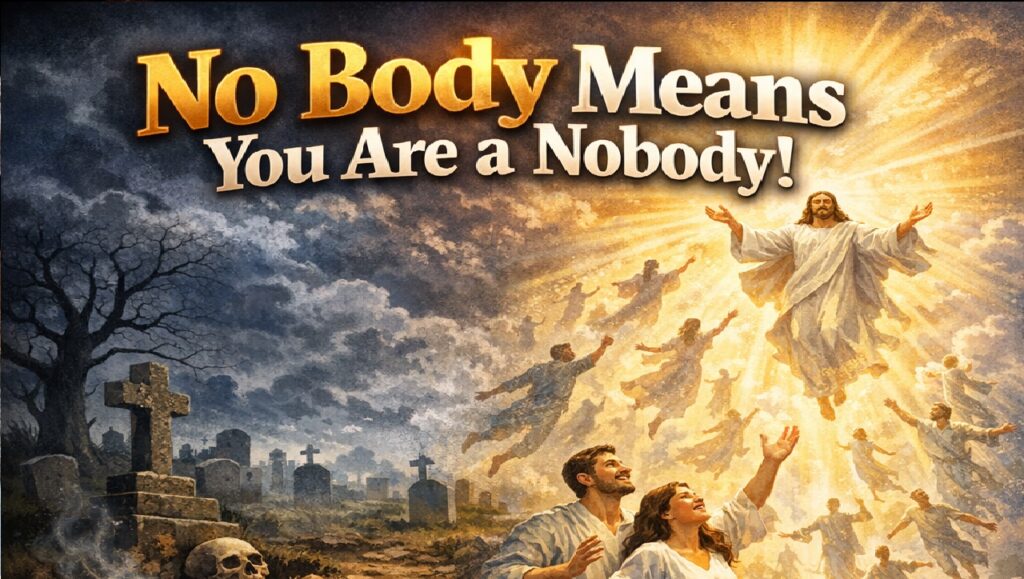
2 Corinthians 5:8 and Philippians 1:23 continue to be used as “proof texts” for the theory that when Christians die they are immediately transferred to heaven to be with Jesus. But when we read Paul in context, and in the light of the whole Bible, a very different picture emerges. His hope is not for a “naked,” i.e., no-body existence, but for the resurrection of his whole person—his soul as body + spirit—a transformed, spiritual body at the parousia. For Paul, no-body means you’re a nobody. The Bible’s view of human nature and of our future hope makes that point very clearly.
Genesis 2:7 says that when Yahweh God formed the man of dust from the ground, He breathed into his nostrils the breath of life (spirit), “and the man became a living soul [or living person].” Notice the human equation: body (dust) + breath of life (spirit) = a living soul/a person. So, in the Bible, you are a soul; you don’t have a soul as a separate, immortal component. When the breath or spirit of God returns to Him, and the body returns to dust, the whole person (the “soul”) is dead, awaiting resurrection (cf. Ps 146:4; Job 14:10-12; Eccles. 12:7; Dan 12:2).
Paul does not change this Hebrew view.
In 1 Corinthians 15:44, 53-54 he contrasts our present “natural body” with the future “spiritual body.” Immortality is something to be put on at the resurrection, not something we already possess as an inner, death-proof spirit. The Christian hope is not to escape the body, but to receive a new kind of body at the parousia, when Jesus will raise Christians from the dead (1 Corinthians 15:22-23).
In 2 Corinthians 5 Paul describes our present mortal life as living in an “earthly tent,” in contrast to the future “building from God.” The latter is future and will come “from heaven.” Paul’s point is not that we go to heaven without bodies, as disembodied “immortal souls”—it is that God has our future resurrection life “stored up” in heaven to be revealed when Jesus comes (cf. Col. 1:5; 1 Pet. 1:4–5).
Therefore, Paul fears being found “naked.” He calls death a state of being “unclothed,” that is, without a body. That condition is not what he is looking for. He calls it “nakedness” because it is a fearful and practically incomprehensible state. What he really desires is to be “clothed” with the resurrection body:
“We do not want to be unclothed, but to be clothed.”
His hope is not a disembodied existence but mortality swallowed up by life in the resurrection. Hence, “We are of good courage… and prefer rather to be away from the body and at home with the Lord.” 2 Corinthians 5:8
Paul is not suddenly contradicting his beliefs grounded on the whole Hebrew Scriptures. His “preference” is to move from this present, groaning mortal condition to the final state when he will be “at home with the Lord”—after his resurrection from the dead. To wrench the words “absent from the body… present with the Lord” out of this context, and to use them to dismiss the resurrection hope, is, as the saying goes, little less than a crime. Paul’s whole focus is the resurrection body; to make Paul teach a disembodied, already-immortal soul is to turn his argument upside down.
Similarly in Colossians 2:5 he is not saying that his “spirit” could be in one place while his body was in another, and therefore that his “immortal spirit” can leave his body at death and go to heaven. This proves far too much, and contradicts other Scripture. James 2:26 says:
“For just as the body without the spirit is dead, so also faith without works is dead.”
If Paul’s “spirit” literally left his body and travelled to Colossae, his body would have been dead in Tarsus or wherever he was writing from! Clearly that’s not what he means. The phrase “present in spirit” is ordinary language for: “I’m not physically there, but my heart, my thoughts, my concern are with you.” We still speak this way today: “I’m with you in spirit,” without imagining that some immortal seperate part of us flies across the world while our body stays home. Paul’s point is a pastoral figure of speech, fully consistent with James 2:26: when the spirit, the life force leaves us, we are dead.
Lastly, Philippians 1:23 is usually read as: “When I die, I’ll go straight to heaven to be with Christ.” But notice how Paul himself explains when he expects to be with Jesus in the very same letter:
“For our citizenship is in heaven, from which also we eagerly wait for a Savior, the lord Jesus Messiah, who will transform the body of our humble state into conformity with the body of his glory.” Philippians 3:20–21
Here the timing is crystal clear:
- We don’t go to our citizenship in heaven;
- Our Savior comes from heaven;
- At his coming, he transforms our body to be like his glorious body.
That’s the same bodily resurrection hope as 1 Corinthians 15.
How can Paul in chapter 1 desire to “depart and be with Jesus,” if he also knows that being with Jesus happens at the resurrection?
The answer is simple once we remember what death is like in Scripture: sleep. From the person’s own point of view, there is no sense of the passing of time between death and resurrection. The next conscious moment after death will be the parousia, which means the resurrection. So Paul can say: “If I continue living, I can serve the churches longer” (Phil. 1:22, 24–25). If he departs (dies), his next conscious reality will be being with Jesus in resurrection glory, which is “far better.” He is not laying out a philosophy of an immortal soul living a conscious life in heaven before the resurrection. He is expressing his personal desire between fruitful ministry now and the final hope of resurrection then.
Paul teaches exactly the same thing in 1 Thessalonians 4:16–18, where the dead in Messiah are not already with the Lord. They must be raised first. Only after the resurrection and catching up “together with them” are we told, “So we will always be with the lord.” Paul says, “Comfort one another with these words,” not with the notion that the dead are already alive and enjoying heaven without bodies. If Paul believed that the faithful dead were already with Jesus in disembodied bliss, his whole argument in 1 Thessalonians 4 becomes strangely pointless. Why talk about the Lord coming down, the resurrection, and meeting him in the air, if dead Christians are already in heaven with Jesus?
When we put all the pieces together, a consistent pattern emerges:
- Human beings are mortal “souls.”
- Body + breath (spirit) = a living soul/person (Gen. 2:7). When the breath or spirit returns to God, the person dies and is described as sleeping.
- Immortality is a gift, not a birthright. It is something our mortal bodies must “put on” at the last trumpet (1 Cor. 15:53).
- Death is a “naked” state, not our goal. Paul calls it being “unclothed” (2 Cor. 5:4). He does not desire that nakedness; he longs for resurrection.
- Being “with the Lord” is tied to the parousia, which means the resurrection.
- For Paul, “the dead in Messiah will rise first… then we… shall together with them… and so we will always be with the lord” (1 Thess. 4:16–17).
- Paul’s desire “to depart and be with Messiah” (Phil. 1:23) is the desire for that resurrection glory, not for a disembodied existence. From his perspective, death shortens the wait: the next thing he will know is being raised and seeing his Lord.
Because for Paul, no-body means you are a nobody!