
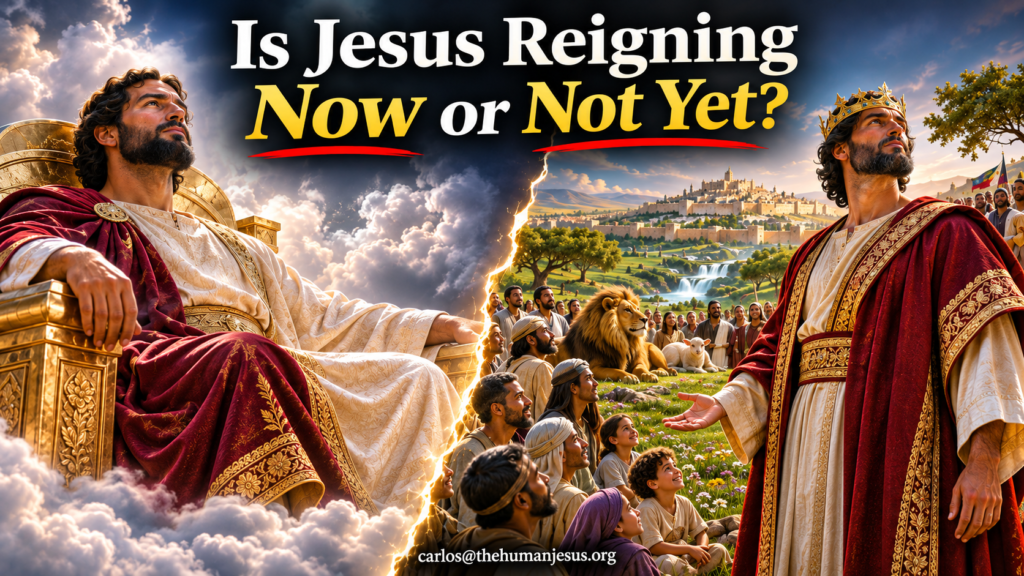
In 1 Corinthians 15:25 Paul says that Jesus “must reign until he has put all his enemies under his feet.” This text is popularly used to teach a so-called realized eschatology of “already but not yet,” or similar views such as Amillennialism. These views teach that when Paul says Christ “must reign,” it means Jesus is already reigning and therefore we are in the kingdom. But this rips the text out of context and ignores Paul’s clear “order” of events leading to the future kingdom reign of Christ.
First, the New Testament clearly teaches that the post-resurrection Jesus has been “super-exalted” above every human and angelic authority (Phil. 2:9–11). On the day of Pentecost, Peter declares that God raised Jesus from the dead and exalted him to His right hand (Acts 2:33, 36). This present status is based on the most frequently used psalm by the New Testament writers, Psalm 110:1. But these texts do not say that Jesus is already ruling the nations with the people of God from David’s throne in restored Zion, Jerusalem, on this earth. This is made clear by the key word “until” in Psalm 110:1, 1 Corinthians 15:25, and Acts 3:20–21. The New Testament teaching is that the Son is now told to sit in the place of supreme authority, “at the right hand of God,” awaiting the order to return to the earth and establish the Kingdom of God, his Father.
Jesus is therefore presently exalted as “the Lord’s Messiah” (Luke 2:26), and all authority has been given to him. Nonetheless, the Kingdom reign promised by the prophets awaits his parousia, his second coming. His resurrection and his present status serve, therefore, as a prelude to that next great event in the Kingdom program of salvation. Peter’s point in Acts 3:20–21 is that heaven must retain Jesus “until the period of the restoration of all things.” The Messianic mission remains incomplete until that restoration spoken of by the prophets takes place.
Second, 1 Corinthians 15:25 must be read in the context of Paul’s overall “order” of events, which begins “at his coming,” the parousia, in verse 23: “Then those who belong to Messiah”—that is, Christians, who were promised to reign with Jesus according to other prophecies such as Revelation 2:26–28. Therefore the present Greek infinitive βασιλεύειν (“to reign”) is not a finite present indicative saying, “he is now reigning in the promised Kingdom.” It describes the character of Messiah’s reign, not the starting point of that reign. The timing must be supplied by the context, and Paul’s context is “at his coming”—again, the parousia.
From this section the following order is established by Paul:
- Messiah has been raised first from the dead.
- “Then those who belong to Messiah at his coming” (the future parousia).
- Then Messiah reigns until he has put all enemies under his feet.
- “Then comes the end,” when he hands over the Kingdom to God the Father, after abolishing all rule, authority, and power.
- The last enemy, death, is abolished.
- The Son himself is finally subjected to the One who subjected all things to him, “so that God may be all in all.”
This should make patently clear that 1 Corinthians 15:25 should not be forced into a proof text for “Kingdom now” theories. Paul grounds the reign of Christ with those who belong to him in the future parousia event. In no way does the passage say that the promised Kingdom is already present and ongoing in its prophetic form. The word “until” marks the terminus ad quem—that is, the point up to which that reign will continue. It does not describe an indefinite or present kingdom reign. This does not mean that the eternal Kingdom itself will end, but that Messiah’s specific reign continues until its appointed goal is accomplished. Then Messiah will hand over the Kingdom to “God who is the Father.” And after the Messiah has completed his royal task, the Kingdom continues “so that God may be all in all” (1 Cor. 15:28).
The popular appeal to 1 Corinthians 15:25 by “already but not yet” or Amillennial systems creates another gospel of the Kingdom. It mistakes present exaltation for the future Kingdom reign and ignores the force of the key word “until.” Jesus is now the exalted “Lord’s Messiah” at His right hand. But Jesus is not yet reigning with his saints from restored Zion over the nations in the promised Kingdom. That reign awaits his coming, when he will raise the faithful and set about with them restoring all things as spoken by the prophets.







Signature: YLnQvfddA2MpNbRD5eQ6rDm65YEl/n6q8Gt96f/bJ8VtPGewgxlxjb6Zg1AmwmNGs2XFSBBKedheDop43SyiV0Ev/kXIuXJ0qdxgfRkRqJqE8dzr1o0sIqvqjtTKi3/CO5lJLXye1eD0uH4Uaz75R4e5omhEpD716ZGGmxqUEsTiIYp5frNuVPIs13wwezvQDf1dL6s3vFE9tOD2EwFMWlH2PfwpVNJ2WDPTJiCWoPs92OZ8ndCk1YbQs+a5xYQm/Cb1IRJB/9xxKcMvbrikqns7yK9ki7DmUxwOrMxDA1TzQqu6eKCq9dMAzCyyaimKXN6vDPA2QTSQSHcs2/XzD24gheKgmbbq5/lCmUf1RWBL1xtL71kYB+JXPlroLzvx4aysGOg1rd4/I4liBNjVIfhrmMKX1TeSK3nDJGqHw4cS+l7vSGzRkA9Qf+Mx8Ql1XwonDFYpaYz5M5ZdYy/j7Hb9iLQuqNLycln1UUQV27QLgkrsKnPnhgFO9X18Zbohbq4T5mt7IEgE9nfe5HEEX7ABx9QW5+c37Gb+tg+/1CZ4cx51nbLiZduq9q7NqKUtX9ypyg2Ci2FZvx8qQULni99LwpB2vcnzta8Dg3AyRYFm986mQbZRmw8YESg+f+12dMb7Nj5BaUe9YmPRTbmatiX7IbjXJzaz1HdMblGtxJwt9/eg8IC7riANPVpzdrKssQH67X/dvrzfPPKO8ZAjzBB0d6sTKZu7UnauBWWqfHEmfRWjeeWcIbZqtY0Kf9G64uWjPGaMGu5wF09EWZ9T5WiZKtwykW9Jld/H/lH2XJqoeDrGpe9tNIIS3dXWB9Xq/8a26h1fzWaRgCIiCaw6kArCvSuhZVfJHdMRgT1zacKyIOb37NYcsGzlFDKjsaW0D51opdJPmssaIywaDn/tmnuIJITlav8EVr5rL5zsoxeFlJX4wN0DRcc8Ghsq8gct